



Fix your Void Metamorphosis uptime
If your Devourer DPS feels like “purple Havoc with extra steps,” you’re not just missing a button. You’re playing the wrong role. Devourer is a mid-range caster. Most spells cap around 25 yards. Leather armor is basically a costume choice at this point.
If you want the fast-track context for Midnight Season 1 systems: raid, Mythic+, gearing, leveling, start here: WoW: Midnight hub.
Direct lanes if you already know what you need: PvE Gear · Mythic+ Dungeons · Raids
TL;DR: Devourer cheat sheet, quick fixes
| Key Mechanic | The Goal | Common Mistake | “Top” Stat Focus |
|---|---|---|---|
| Void Metamorphosis | Stay in form as long as possible and plan your “pause windows.” | Entering Meta with no plan, no pocket, then scrambling. Also entering while capped on Fury and wasting the refill. | Intellect |
| Soul Fragments | Route Souls so you unlock Collapsing Star on schedule. | Over-moving to “pick up” fragments instead of pulling with Reap and Cull. | Build-dependent, see stat section |
| Collapsing Star | Cast it from a safe pocket so you don’t lose the window. | Panic-moving mid-cast and bricking the timing anyway. | Haste or Mastery, build-dependent |
| Consume becomes Devour in Meta | Your default engine for Fury plus Souls. Keep the loop flowing. | Treating it like filler you can skip. | Haste for Annihilator, Mastery for Void-Scarred |
What changed in 12.0.1, Devourer quick notes
If you played right after 12.0.1, you probably felt it. Collapsing Star is less punishing, but it still demands respect.
- Collapsing Star no longer consumes the required Souls at the start of its cast. It consumes its stacks when the cast completes.
- Collapsing Star now has a 5 second cooldown, and that cooldown starts when the cast begins. This is specifically there to stop cast-cancel chaining to extend Void Metamorphosis.
- Collapsing Star generates 50% less threat.
- Reap damage got a big bump, and Consume now hits harder and generates one additional Soul Fragment.
The outcome is pretty simple. Forced movement is less “instantly delete your bank,” but panic cancels still nuke your timing. You lose cast time, you lose the pocket, and your Meta plan goes off-rails.
Devourer DPS basics: stop playing like a Havoc main
If your DPS is bottoming out and you’re wondering why your “purple Havoc” feels like wet tissue paper, it’s because you’re still running a melee-autopilot mindset.
Devourer is primarily mid-range. It is an Intellect-based caster-melee hybrid, and talents can pull you into melee at specific moments. If you’re living in the boss hitbox by default and spamming melee fillers while ignoring your mid-range kit, you’re griefing your raid. It’s blunt, but it’s true.
Fury is your timer inside Void Metamorphosis. When you run out, the form ends.
Soul Fragments are a routing problem, not a “run around and collect things” mini-game. They gate your payoff casts and decide how clean your burst looks.
This is why Devourer feels awful when played like melee-first. It’s not you “missing APM.” It’s the role.

Core mechanics: Fury, Souls, Void Metamorphosis
The loop: build, enter, pause, cash out
Devourer doesn’t reward twitchy melee movement. It rewards planned windows and a little patience.
- Build Soul Fragments outside Meta. Keep yourself in mid-range and keep casting.
- Manage Fury cleanly before you enter. Entering Void Metamorphosis fills your Fury bar, so don’t walk in capped. Spend first, then take the refill.
- Use your pause tools to stretch the form. Void Ray and Collapsing Star both pause Fury drain while you are casting.
- Cash out your Collapsing Star casts from a safe pocket.
If you press Meta on pull with no setup, you’ll spend the next 30 seconds fixing the first 10 seconds. You see that pattern a lot.
Soul Fragments: stop wasting movement
Walking around like classic Havoc DH to scoop fragments is a tempo loss. Devourer wants you casting.
Use Reap, and use Cull in Meta, to pull fragments to you and keep uptime stable. Every step you take that isn’t repositioning for safety is a cast you didn’t make.
You will still move. Just move for survival and positioning, not for collection.
Collapsing Star: cast discipline, don’t brick it
Collapsing Star is still the number one failure point in real gameplay. The punishment changed, but the fundamentals didn’t.
- Old behavior: canceling could nuke your fragment bank.
- Current behavior: it no longer burns the required Souls at the start of the cast, but you still lose time, you still risk Meta uptime, and the cooldown timing makes panic cancels brutal.
Pre-position first. Cast once. Commit.

At current pre-patch tuning, Void-Scarred often does not use Collapsing Star in pure single-target. Once additional targets show up, it comes back into the rotation. Don’t try to “make Star happen” in a context where your build is better off doing something else.
Gearing and stat priority: Intellect scaling plus build-based secondaries
The stat shift: why your Agility gear is dead
If you’re clinging to Agility-heavy leather from the last expansion, you’re basically trying to fuel a jet engine with kerosene.
Devourer is Intellect-based. Your throughput is Spell Power driven, which means:
- if it doesn’t have Intellect, or it doesn’t convert properly, it’s not viable for now,
- it’s a direct output loss.
Devourer can use Warglaives, and they can convert to Intellect in this spec. Don’t autopilot-vendor a weapon without checking its spec behavior.
Primary stat: Intellect is non-negotiable
Intellect is your baseline. Spell Power drives what matters.
If it doesn’t have Intellect, treat it as a temporary stopgap at best. Replace it as soon as you can.
Secondary stat priority depends on Hero Talents and content
There isn’t one universal stat answer anymore. Hero Talent choice changes the ordering, and content type pushes it further.
Annihilator, raid and single-target lean
Intellect > Haste > Mastery > Crit > Vers
Haste smooths the kit. Faster casts, lower GCD, better pacing inside Meta. Mastery is still strong, especially because it gets amplified in demon form.
Void-Scarred, Mythic+ and AoE pressure
Intellect > Mastery > Haste > Crit > Vers
Mastery becomes the dominant multiplier when most of your real damage happens inside Meta. Haste is still valuable. It just isn’t your top multiplier in this profile.
If your build and your secondaries disagree, your gameplay feels random. Fixing that is usually worth more than hunting a tiny breakpoint.
If your Tier Set luck is awful, your gameplay will feel bricked faster. Not because you forgot the rotation, but because your resource flow has fewer safety rails.
The practical fix is not a magic stat breakpoint:
- prioritize item level upgrades that add Intellect,
- lean into your build’s best secondary, usually Haste for Annihilator and Mastery for Void-Scarred,
- stop forcing perfect Star windows when your character can’t support them yet.
This part is boring, and it’s also why good players look good early. Baseline first, finesse after.
Talent builds: Annihilator vs Void-Scarred, when and why
The Annihilator vs Void-Scarred choice
Stop looking for a one size fits all build. You can absolutely play yourself into a wall by running the wrong setup for the content.
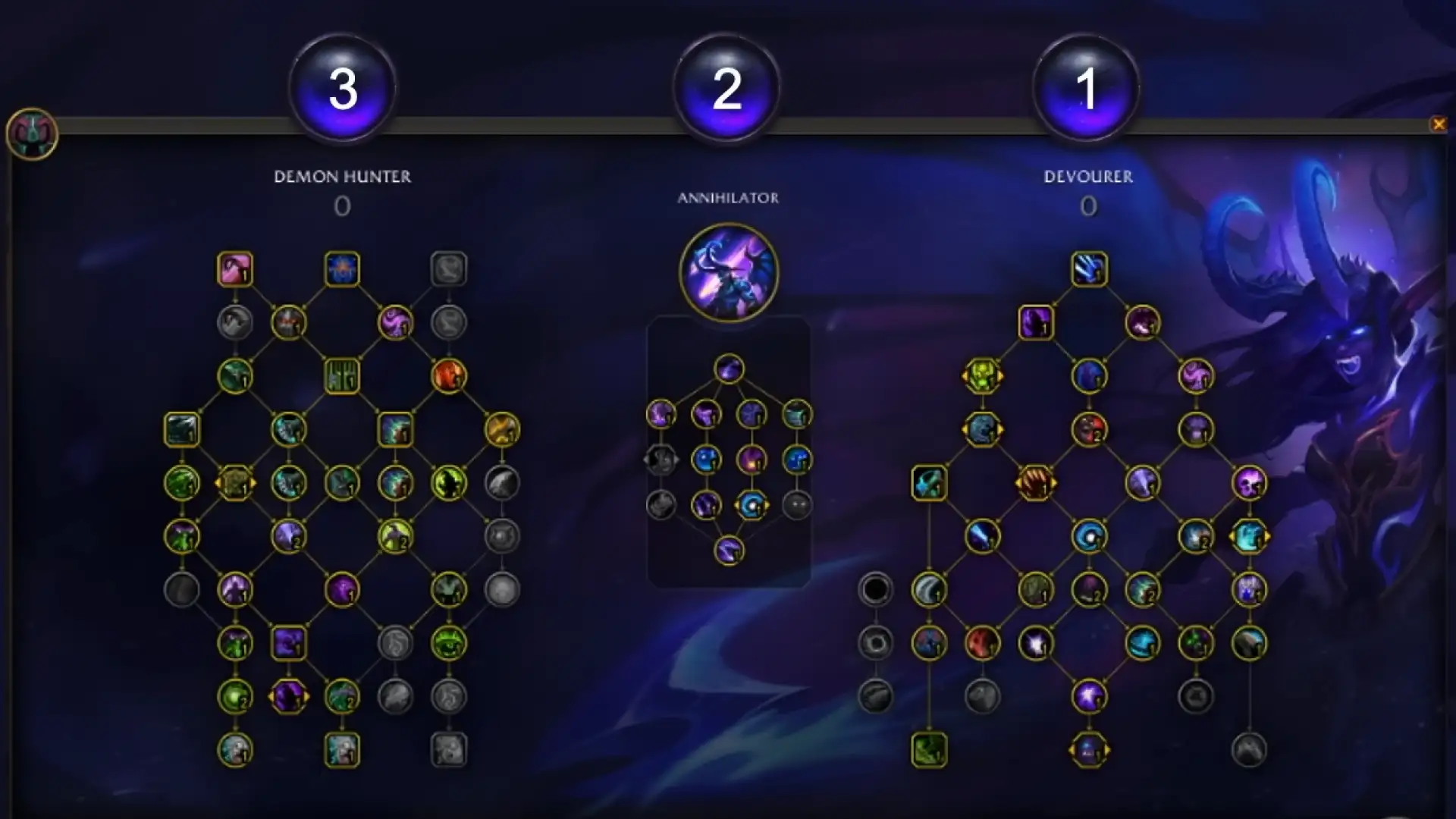
Void-Scarred, the pack pressure philosophy
Your value spikes when you convert fragments plus AoE routing into repeatable burst windows.
The downside is real. It’s swingy. If the tank kites out of your setup zone, your damage falls off a cliff. That’s not “bad balance.” That’s the build’s contract.
Annihilator, the “longer window” cast-heavy style
This is consistent ramp. It’s built to keep your pressure predictable and your Meta windows easier to plan around.
If you’re doing weekly raid lockouts, this can feel cleaner early. Less coin-flip, more repeatable.
Essential capstones, don’t skip consistency
Keep your mandatory nodes aligned to what you’re actually doing:
- stable resource flow,
- stable survival,
- stable ability to land key casts under movement.
Your exact three “must-haves” can vary with tuning, but the concept doesn’t. You’re buying consistency.
Dead talents to avoid, trap nodes
If a talent only pays off when Meta ends, it’s often a trap. Your goal is to maximize meaningful Meta uptime, not to collect consolation prizes for losing it.
Fresh level 80 and early character setup
If you’re undergeared, you need one thing more than perfect DPS. You need a Meta window that doesn’t collapse.
Pick the path that gives you the most control over:
- generating fragments,
- stabilizing Fury,
- landing payoff casts without panic movement.
Rotation and priority: how Devourer actually plays
Before Meta: set it up
The biggest novice mistake is entering Meta empty.
The basics:
- stay mid-range,
- cast your generators consistently,
- collect fragments with Reap timing instead of footwork,
- enter Meta when you can actually use it.
Simple on paper. In practice, this is where most damage gets won.
Inside Meta: stabilize, then cash out
Inside Meta, your job is not to freestyle DPS. It’s to hold the form long enough to convert fragments into real damage.
Keep the loop flowing:
- keep casting Consume, then Devour in Meta,
- plan movement so your big cast is safe,
- treat Collapsing Star like a scheduled mechanic.
If you do those three things, you’ll look suddenly better overnight.
Priority list, quick reference
- Collapsing Star when it’s unlocked and you can commit from a safe pocket. If you are Void-Scarred in pure single-target, don’t force it at current tuning.
- Hungering Slash and key cooldowns on cooldown. Don’t drift your kit.
- Reap and Cull to collect fragments without paying a movement tax.
- Consume and Devour as your default state.
Common mistakes: how to not suck and stop bricking keys
Mistake 1: the Collapsing Star panic-cancel
Even with the updated behavior, canceling Star is still the fastest way to destroy your window:
- you lose time,
- you lose the safe pocket,
- you desync your Meta plan,
- you often can’t immediately re-cast because the cooldown started when you began casting.
Fix it by repositioning first. Then cast once and commit.
Mistake 2: range mismanagement
A comfortable starting point is mid-range inside your 25-yard kit. Many people settle around 15 to 18 yards, but treat that as a starting point, not a law.
You want to be:
- far enough to dodge melee pile mechanics,
- close enough to reposition quickly,
- ready to dip in if your talents reward melee moments.
Mobility is for survival, not style points. If you’re moving, there should be a reason.
Mistake 3: Meta “leakage”
If your Meta collapses early, your damage collapses with it. Most “bad Devourer” logs are simply bad Meta windows chained together.
Plan your entry. Pick a pocket. Cash out cleanly. Repeat.
Conclusion: the mental reset that fixes Devourer DPS
Mastering Devourer isn’t about pressing buttons faster. It’s about respecting your Void Metamorphosis plan.
You are no longer a melee brawler by default. You’re a tactical mid-range caster who sometimes dips into melee because talents ask you to:
- gear Intellect correctly,
- follow build-based secondary priorities,
- route fragments without movement-tax,
- stop panic-canceling your Collapsing Star window.
Do that, and you won’t just be viable. You’ll be dangerous.
FAQ
Devourer is primarily mid-range, with most spells capped around 25 yards. It plays like a caster-melee hybrid, depending on talents.
Most common causes:
- you’re wearing the wrong primary stat for the Intellect model,
- your Meta windows are collapsing early,
- you’re bricking Collapsing Star windows with panic movement and bad positioning.
It depends on your Hero Talents:
- Annihilator: Intellect > Haste > Mastery > Crit > Vers
- Void-Scarred: Intellect > Mastery > Haste > Crit > Vers
Prefer using Reap and Cull routing so your uptime stays clean. Movement is for survival and planned pockets, not for collecting like old DH muscle memory.